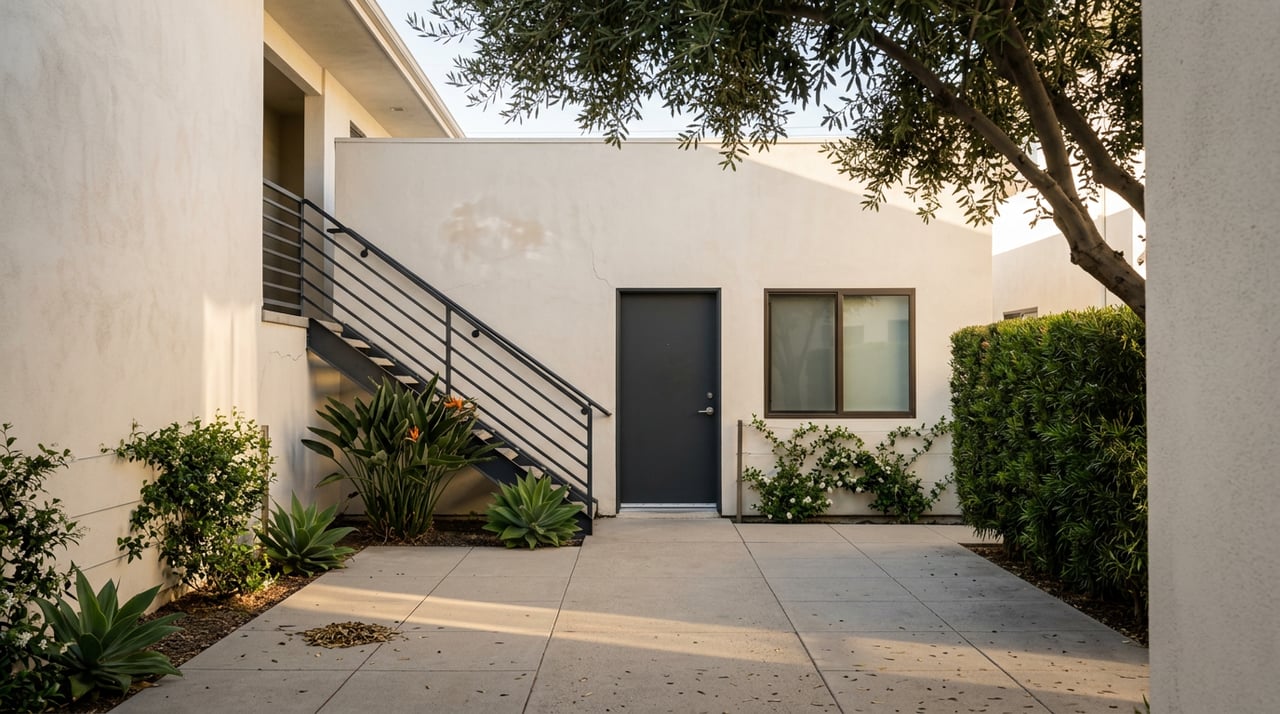
In July 2026, CIM Group and Hulic Co. closed on Domain WeHo, a 166-unit apartment community inside city limits, according to Connect CRE's coverage of the deal. That is not a small transaction, and it did not happen quietly. It happened in a city with the tightest annual rent increase cap on the Westside, in a rental market where county-wide rents were flat to declining through the first half of the year.
If you are comparing a small multifamily property in West Hollywood against something similar just across the line in Fairfax or Beverly Grove, that deal should raise a question. Why would sophisticated capital choose the market with the strictest rent rules over the one next door with looser ones? The answer is not about rent growth. It is about what happens on the way out.
The Rent Cap Story Everyone Already Knows
Start with the part of this that is genuinely unfavorable to a West Hollywood owner. The city's Rent Stabilization Ordinance caps the annual general adjustment at 2.25 percent for the current cycle, which runs through August 31, 2026. That figure is set each spring by the Rent Stabilization Commission at 75 percent of the regional Consumer Price Index, with a permanent ceiling of 3 percent no matter how high inflation runs.
Compare that to the City of Los Angeles's own rent ordinance, LARSO, which covered most pre-October 1978 buildings at a flat 3 percent through June 30, 2026. As of July 1, 2026, that formula changed to 90 percent of CPI, with a 1 percent floor and a 4 percent ceiling. In practice, that means a comparable pre-1979 building sitting just outside West Hollywood, in Hollywood or the Fairfax district, can now see rent increases running a full percentage point or two higher each year than an identical building inside WeHo's boundary.
On income growth alone, West Hollywood is the harder market to operate in. That is the story most people stop at. It is also the wrong place to stop.
The Line on a Map That Changes the Math
Measure ULA, Los Angeles's transfer tax on high-value real estate sales, only applies inside the City of Los Angeles. West Hollywood was incorporated as its own city in 1984, a year before it adopted its rent ordinance, and it has never been subject to Measure ULA because the tax was never written to reach beyond LA's municipal boundary.
The current thresholds took effect for any transaction closing after June 30, 2026: a 4 percent tax on sales between $5,400,000 and $10,900,000, and a 5.5 percent tax on anything at or above $10,900,000, according to the City of Los Angeles Office of Finance's Measure ULA FAQ. Those thresholds move up slightly every July 1 based on the Chained CPI. A year ago they sat at $5.3 million and $10.6 million.
Here is what that means for two buildings that are otherwise identical, one on each side of the WeHo line.
| City of Los Angeles parcel | West Hollywood parcel | |
|---|---|---|
| Governing rent ordinance | LARSO | WeHo RSO |
| Current annual increase cap | 90% of CPI, 1% floor, 4% ceiling (since July 1, 2026) | 2.25% (through August 31, 2026) |
| Measure ULA on a $7,000,000 sale | $280,000 | $0 |
| Measure ULA on a $10,900,000 sale | $599,500 | $0 |
| Mandatory soft-story retrofit ordinance | LA Ordinance 183893, Priority 2 deadline April 2026 | WeHo Ordinance 17-1004, adopted 2017 |
Those tax figures are not estimates. They are the rate applied directly to gross sale price at closing, calculated at 4 percent on $7 million and 5.5 percent on $10.9 million. A seller who closes the same building for the same price on the West Hollywood side of the boundary never pays either amount, because the tax does not reach that address.
What the Exemption Is Actually Worth
This is the number that does not show up in a listing description or a rent roll. It shows up in the proforma a buyer runs before making an offer, and it is large enough to change how much that buyer can pay.
A $10.9 million sale crossing into Measure ULA's top bracket carries a $599,500 tax bill that exists purely because of which side of a street the parcel sits on. That is money a City of LA seller hands over at closing regardless of what the property nets in rent. A buyer underwriting two otherwise comparable deals, one inside WeHo and one a few blocks away in the city, can rationally bid more for the WeHo asset and still land at the same net cost, because the tax exposure on the exit is different by hundreds of thousands of dollars.
That gap helps explain why a buyer like CIM Group would choose a West Hollywood address over an adjacent submarket even with a tighter rent cap sitting on top of the rent roll. The stricter annual increase limits how fast income grows year to year. The ULA exemption changes what the building is worth the day it eventually sells. For an institutional buyer running a five or ten year hold, the second number can matter more than the first.
There is a second, quieter piece to this. West Hollywood buildings often carry long-tenured, rent-stabilized tenants whose in-place rent sits well below what the same unit would command on the open market today. That gap between in-place and market rent is exactly what value-add buyers are underwriting toward. The annual cap slows how fast that gap closes, but it does not erase it, and a buyer willing to hold through turnover still captures the upside eventually.
The Bill Sitting Behind the Savings
None of this makes West Hollywood multifamily a clean arbitrage, and a piece that only counted the ULA savings would be selling something rather than explaining it.
West Hollywood adopted its own mandatory seismic retrofit ordinance, 17-1004, on April 17, 2017, targeting wood-frame buildings with soft, weak, or open-front ground floors, the classic tuck-under parking design common across the city's older apartment stock. The city's own retrofit survey identified more than 700 buildings that fall under the ordinance. Retrofit construction costs on buildings this size typically run from the low tens of thousands into the low hundreds of thousands of dollars depending on unit count and structural condition, and the city's Phase 1 design grant window closes on September 1, 2026, with no further extensions expected.
If you are underwriting or selling a pre-1979 WeHo building right now, that deadline is close enough to matter. A building that has already completed its retrofit and can document it closes cleaner and faster. A building still working through the process carries a cost a buyer will price into any offer, and that cost sits on the same balance sheet as the ULA savings. The honest way to run these numbers is to net them against each other, not to count one and ignore the other.
What This Means If You're Comparing Both Sides of the Line
If you own, or are evaluating, a small multifamily property near West Hollywood's border with Beverly Hills, Hollywood, or Fairfax, the decision is not simply which city has friendlier rent rules. It is whether the property's likely sale price puts it anywhere near the Measure ULA thresholds, and whether the building's age and structure put it inside WeHo's soft-story program.
A ten-unit building that might sell for $6 million sits squarely inside the 4 percent ULA bracket if it is in the City of Los Angeles, and entirely outside it if it is in West Hollywood. That single fact can be worth more to a seller's net proceeds than a year or two of the rent increase difference between the two ordinances. Before you price a comparison between neighborhoods on either side of that line, confirm with your title company or escrow officer exactly where the parcel sits, since some blocks near La Cienega, Fountain, and Beverly run close enough together that the incorporated boundary is not always obvious from the street.
A Few Direct Questions
Does Measure ULA ever apply to a property inside West Hollywood? No. Measure ULA is a City of Los Angeles ordinance. It has no reach beyond that city's incorporated boundary, and West Hollywood has operated as its own independent city since 1984.
Is West Hollywood's rent cap actually stricter than the rest of Los Angeles right now? Yes, for the current cycle. WeHo's allowable increase sits at 2.25 percent through August 2026, while LARSO's new CPI-based formula, in effect since July 1, 2026, allows up to 4 percent depending on inflation that year.
How do I confirm a property is actually within West Hollywood's boundary before I count on the ULA exemption? Ask your escrow or title company to confirm the parcel's jurisdiction before you rely on it. Streets near the WeHo border can shift between city jurisdictions block by block, and the exemption only applies to sales where the property itself sits inside West Hollywood's incorporated limits.
If you are weighing a multifamily purchase, sale, or hold decision on either side of West Hollywood's boundary, Joel + Dorit Cooper can walk through the specific numbers for your building, including the retrofit status, rent roll, and jurisdiction that determine what it is actually worth today. Schedule a consultation to run the math on your property before you price a decision on assumptions alone.